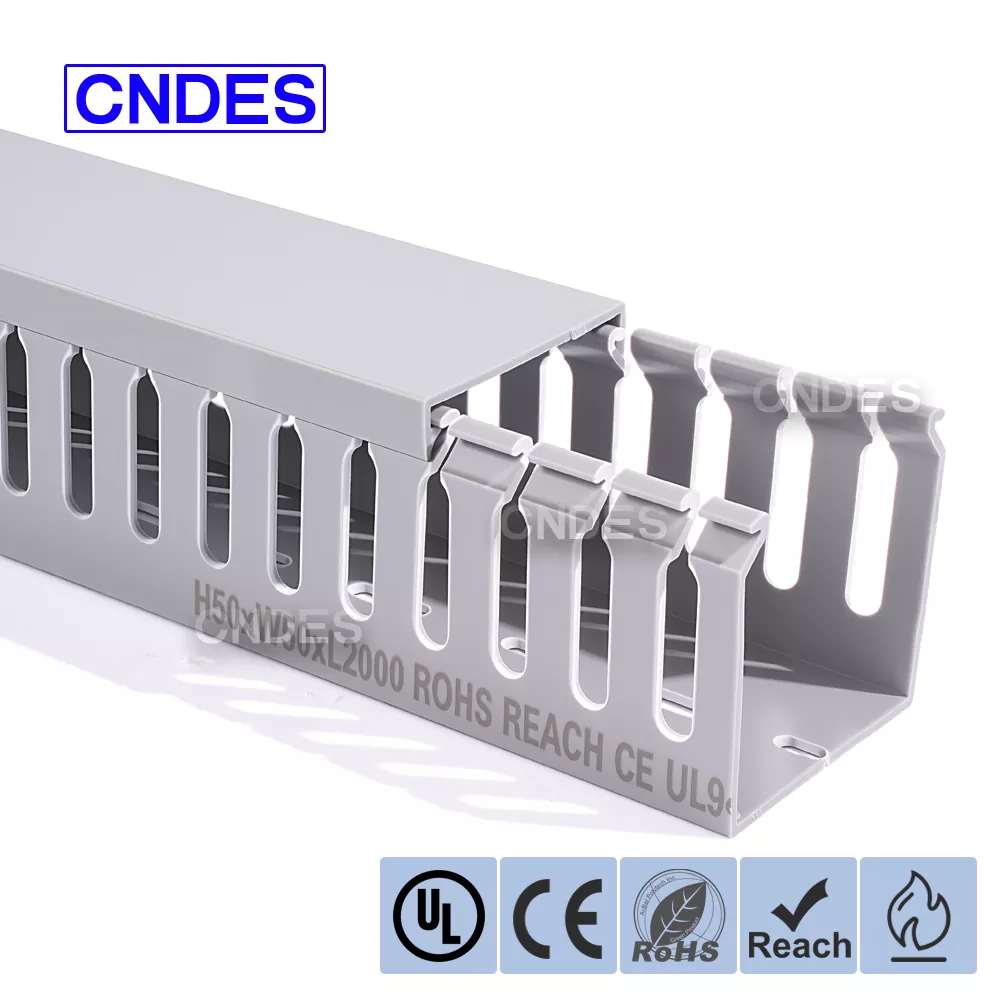
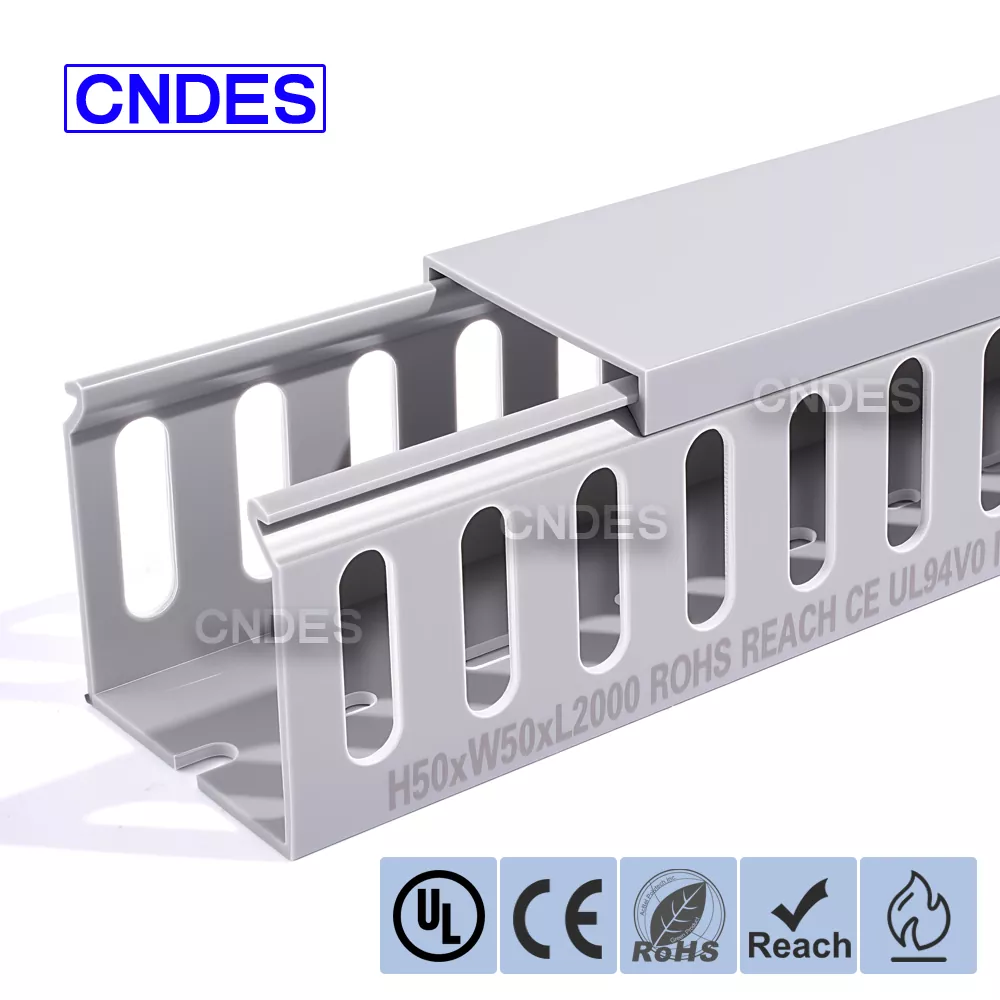
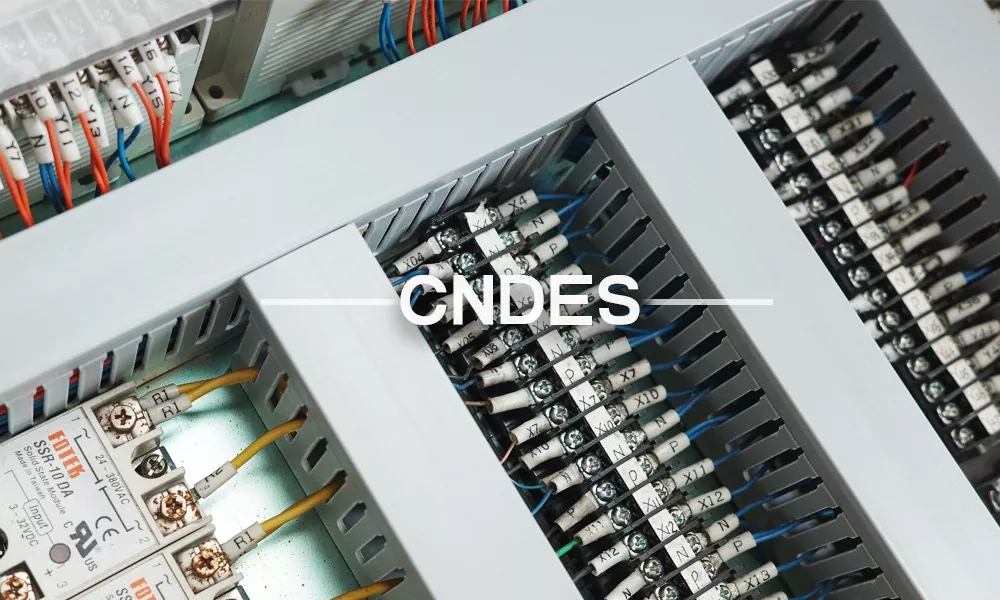
The Customized 50×50 Slotted PVC Finger Type Wiring Duct is designed for efficient cable organization in electrical panels, automation cabinets, and industrial control systems. Featuring a balanced square profile and finger-type open slots, this wiring duct enables fast cable branching, clean routing, and easy maintenance.
Manufactured by CNDES, a professional PVC wiring duct manufacturer and supplier in China, this model is widely used in applications requiring flexibility, safety, and long-term durability.
|
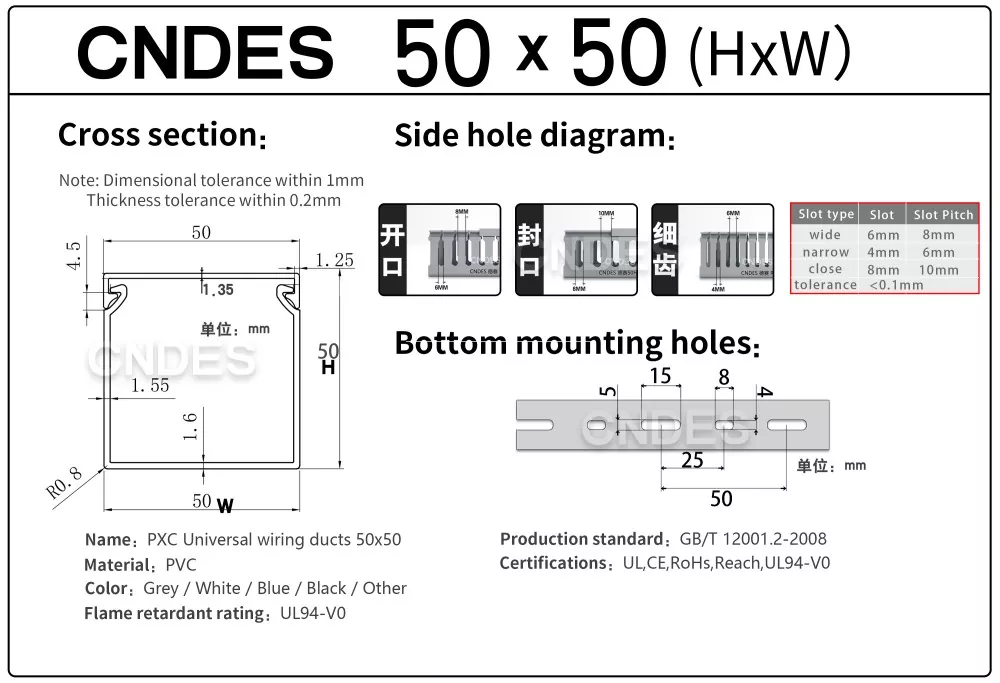
Material |
PVC |
|
Certification |
UL, CE, RoHS, REACH |
|
Installation Temperature |
-40°C up to 70°C |
|
Color |
Gray or other custom colors |
|
Perforated bottom |
With Bottom Mounting Holes |
|
Package |
100m |
|
thickness |
1.55mm |
50*50-Specification document
Before installation, select the appropriate conduit size and slot width according to the cable quantity, cable diameter, and installation environment, such as available space and operating temperature.
For example, narrow finger-type slot designs are suitable for high-density component areas, while wider slots allow easier routing of larger cable bundles.
When installing the Quality 50×50 Slotted PVC Finger Type Wiring Duct, plan the cable routing path in advance and mark the mounting positions on walls or inside electrical cabinets. Avoid areas with sharp edges, excessive vibration, or high temperatures.
Use a tape measure and marker to ensure accurate positioning and smooth routing.
Prepare the necessary tools, including a screwdriver, power drill (if drilling is required), level, and cutting tools such as a saw or dedicated wiring duct cutter.
If mounting to a wall or cabinet, use a power drill to bore holes at the marked points. Insert expansion anchors or plastic anchors. Ensure the drill hole diameter matches the anchor size to prevent instability from oversized holes. Align the Slotted PVC Finger Type Wiring Duct base rail with the mounting points and tighten screws using a screwdriver to ensure the rail is secure and does not wobble. Prioritize using the conduit's pre-drilled mounting holes. If additional fixing points are needed, drill holes yourself. Use a level to check the base channel's horizontal alignment, preventing difficulties with subsequent cover plate installation or cable tilt. After adjustment, retighten the screws to prevent shifting.
Before inserting cables, group them according to function—such as power cables, signal cables, or data cables—and label them if necessary. Check that the cable diameter is compatible with the slot width.
Insert cables gently through the side slots or end openings of the High-Performance 50×50 Slotted PVC Finger Type Wiring Duct, avoiding excessive pulling that may damage cable insulation.
For larger cables, individual slot “fingers” can be removed along pre-cut lines or trimmed using cutting tools to create wider openings.
Arrange cables in layers to improve organization and future maintenance. A common practice is to place power cables at the bottom and signal cables on the upper layer to reduce interference.
Align the cover plate with the base channel, ensuring the cover plate edges fully engage with the base channel's clips or slide grooves. For sliding cover plates, slide them in from one end; for clip-on types, press until locked into position. Firmly press the cover plate to secure it tightly to the base channel. For Slotted PVC Finger Type Wiring Duct, rotate the cover plate to the locked position. Inspect the cover plate for levelness to prevent localized lifting that could allow dust ingress. Verify the cover plate is secure with no gaps to prevent dust or foreign objects from entering the conduit interior. If enhanced sealing is required, apply sealant to the cover plate edges (select a PVC-compatible adhesive).
When installing on vertical surfaces, select covers with anti-slip designs (e.g., rubber pads or snap-reinforced types) to prevent slippage. Periodically inspect vertically installed Slotted PVC Finger Type Wiring Duct to ensure covers remain secure against gravitational loosening. In confined spaces, cut conduits to suitable lengths (using specialized cutting tools to maintain clean, flush edges). After cutting, inspect the cut edge for sharpness. Sand with abrasive paper if necessary to prevent cable or operator injury. If ambient temperatures approach the conduit's upper temperature limit (e.g., 50°C or 85°C), select a high-temperature-resistant model or implement additional heat dissipation measures. For example, reserve ventilation space around the conduit or install cooling fans.
Looking for a reliable 50×50 slotted PVC finger type wiring duct supplier or manufacturer in China?
Contact CNDES today to receive samples, technical drawings, or a factory-direct quotation.
Address
Huanghua Qitou Industrial Zone, Yueqing City, Wenzhou, Zhejiang Province, China
Tel